
Contents
Parking tiles take more punishment than any other surface in a home — point loads from tyres, thermal movement, oil, monsoon water. Most failures come from choosing a tile that was never rated for it.
What a parking tile actually has to survive
A car concentrates well over a tonne onto four contact patches, and it drags that load sideways every time the wheel turns while stationary. Add direct sun, standing water and fuel spills, and the specification narrows quickly.
- Thickness — 15mm and above for a driveway. Standard 8–10mm floor tile will crack.
- Water absorption — below 0.5%, so freeze and monsoon cycles do not work the tile loose.
- Slip rating — R11 minimum, R12 on any slope.
- Full body construction — the pattern runs through the tile, so a chip does not show a pale core.
Formats that work
Smaller formats outperform large ones here, which is the opposite of indoor advice. More joints means more places for the substrate to move without transferring stress into the tile.
- 300x300mm heavy-duty parking tiles — the default, and the easiest to replace singly.
- 400x400mm — fewer joints, still manageable loads.
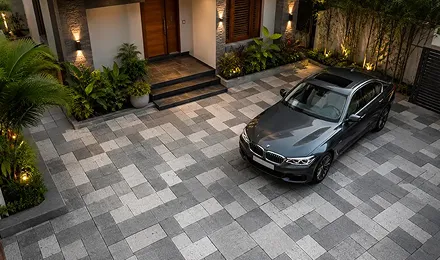
- Interlocking pavers — best where the ground may settle, since individual units can be lifted and relaid.
Laying matters more than the tile
Most parking tile failures are bed failures. A tile laid on an inconsistent bed has voids beneath it, and a void under a wheel path becomes a crack within a season.
Full-bed coverage, not five dabs of adhesive. Anything less and the tile is a bridge over an air gap with a car parked on it.
Falls and drainage
Aim for a 1:80 to 1:100 fall away from the building. Standing water is what turns a minor grout failure into a lifted tile.
Patterns
Staggered and basketweave layouts distribute load better than a straight grid and hide the inevitable staining more gracefully. Mixing two close tones across the area disguises the tyre tracks that eventually appear along the driving line.
Getting the specification right
Thickness, absorption and slip rating are all published for every tile we make — the figures are in the technical sheets in our catalogue library.