
Contents
Bathroom tiles are the one finish in a home that has to be beautiful, waterproof, walkable when wet and still looking right a decade later. This guide covers how to choose them for an Indian home in 2026 — the sizes worth using, the finishes that hold up, and what each budget band genuinely buys.
Start with the size, not the pattern
Almost every bathroom that feels cramped has been tiled in a format too small for it. Grout lines read as visual noise, and the more of them there are, the busier and smaller the room looks. Larger formats have fewer joints, which is why a 600x1200mm tile makes a compact bathroom feel considerably more open than a 300x300mm one, even in the same colour.
As a rough starting point:
- Under 35 sq ft — 600x600mm floors, 600x1200mm walls. Keep the wall and floor tone close.
- 35 to 70 sq ft — 600x1200mm throughout, which is the most flexible size in the Indian market.
- Over 70 sq ft — 800x1600mm or slab formats, where the surface can read as one continuous plane.
The instinct to use small tiles in a small room is backwards. Small tiles suit small details — a shower niche, a step, a curved wall — not whole rooms.
What about the shower floor?
This is the one place a smaller format earns its keep. A shower floor needs a fall towards the drain, and a tile has to be small enough to follow that slope without rocking. Anything up to 300x300mm works; mosaic sheets work best of all, and the extra grout gives you grip exactly where you need it.
Finishes, and the slip question
Finish decides how a bathroom behaves far more than colour does. There are four in common use, and only two of them belong on a floor.
| Finish | Where it works | Notes |
|---|---|---|
| Glossy | Walls only | Reflects light, makes rooms feel larger. Dangerous underfoot when wet. |
| Matt | Floors and walls | The safe default. Hides water spots and limescale. |
| Satin / soft | Floors and walls | A middle ground with some sheen but usable grip. |
| Carved / structured | Feature walls, shower floors | Texture adds grip and shadow. Needs more care when cleaning. |
If you take one thing from this section: check the R rating before the colour. R10 is the practical minimum for a bathroom floor in a family home, and R11 is worth it if there are young children or elderly parents using the room.
A bathroom floor that looks perfect and is slippery when wet is a failed bathroom floor. Grip is not a compromise on design — it is part of the specification.
Building a scheme that still works in five years
Bathrooms are renovated far less often than bedrooms or living rooms, so a scheme has to survive changes in taste. The schemes that age best follow a simple structure.
- Pick a base. One quiet tile — a soft stone, a warm off-white, a pale concrete — for the majority of the walls and the floor.
- Pick one feature. A single wall, usually the one behind the basin or the wet area, in a marble, a deeper tone or a carved texture.
- Match the grout to the base. Contrasting grout is a trend; matching grout is a decision you will not regret.
- Let the metals carry the personality. Taps, hinges and mirror frames are cheap to change. Tiles are not.
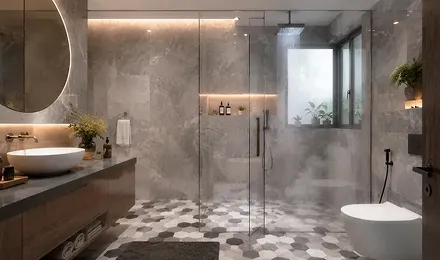
One quiet base, one feature wall, matching grout — the structure holds up regardless of which colours are fashionable.
Colours that are holding in 2026
Warm neutrals continue to replace the cool greys that dominated the last decade. Greige, bone, oatmeal and sand all sit comfortably with both brass and matt black fittings, which is what makes them safe. Deep greens and burgundies are appearing on feature walls, generally in a glossy or carved finish so the depth of colour has somewhere to catch light.
A note on wood-effect tiles
Wood-effect porcelain has become genuinely convincing, and unlike real wood it does not mind standing water. In a bathroom it works best on the floor with plain walls above, rather than the reverse.
What each budget actually buys
Prices below are indicative per square foot for the tile alone, before laying. Labour, adhesive and waterproofing typically add ₹60–₹120 per square foot depending on the city and the format.
- ₹40–₹70 — ceramic wall tiles and basic vitrified floors. Fine for a service or guest bathroom. Expect a limited palette and visible repetition across the room.
- ₹70–₹130 — glazed vitrified in 600x600mm and 600x1200mm, with a proper range of finishes. This is where most family bathrooms should sit.
- ₹130–₹250 — large formats, better print resolution, more faces per design so patterns repeat less often.
- ₹250+ — slab porcelain in 800x1600mm and above, book-matched marble effects, and full-body options that carry the pattern through the thickness of the tile.
The jump from the first band to the second is the one that shows. Beyond that you are buying scale and rarity rather than durability — a ₹90 glazed vitrified tile and a ₹300 slab will both outlast the fittings around them.
Five mistakes worth avoiding
- Choosing tiles before finalising the drainage layout, then discovering the fall cannot be made to work.
- Using a glossy floor because it matched the walls.
- Ordering exactly the measured quantity. Add 10% for cuts, 15% for large formats or diagonal layouts.
- Mixing batches. Shade varies between production runs — buy the whole job at once and check the batch number on every box.
- Skipping the sample. A 600x1200mm tile looks different in a bathroom than it does under showroom lighting.
Where to go from here
If you are at the stage of narrowing down formats and finishes, the product catalogues list every size and surface currently in production, with the technical data for each. For a broader look at combinations that work in Indian homes, our design ideas collection covers twenty-five schemes in detail.